
The HHB Electric Chain Hoist is designed for lifting applications where vertical installation space is limited. Its low-headroom structure helps reduce the space occupied above the hook, allowing more of the available building height to be used for lifting. This makes the HHB series a practical choice for workshops, warehouses, production facilities and other sites where ceiling height or headroom is restricted.
Daikuhsa offers HHB electric chain hoists in different configurations to suit fixed lifting and beam travel applications. The range includes 3-phase models from 0.25 t to 10 t, as well as 1-phase/3-phase trolley-mounted models from 0.5 t to 10 t, depending on the configuration. Trolley versions allow loads to move horizontally along a suitable beam, while fixed models are intended for lifting from a designated position.
Product Catalog
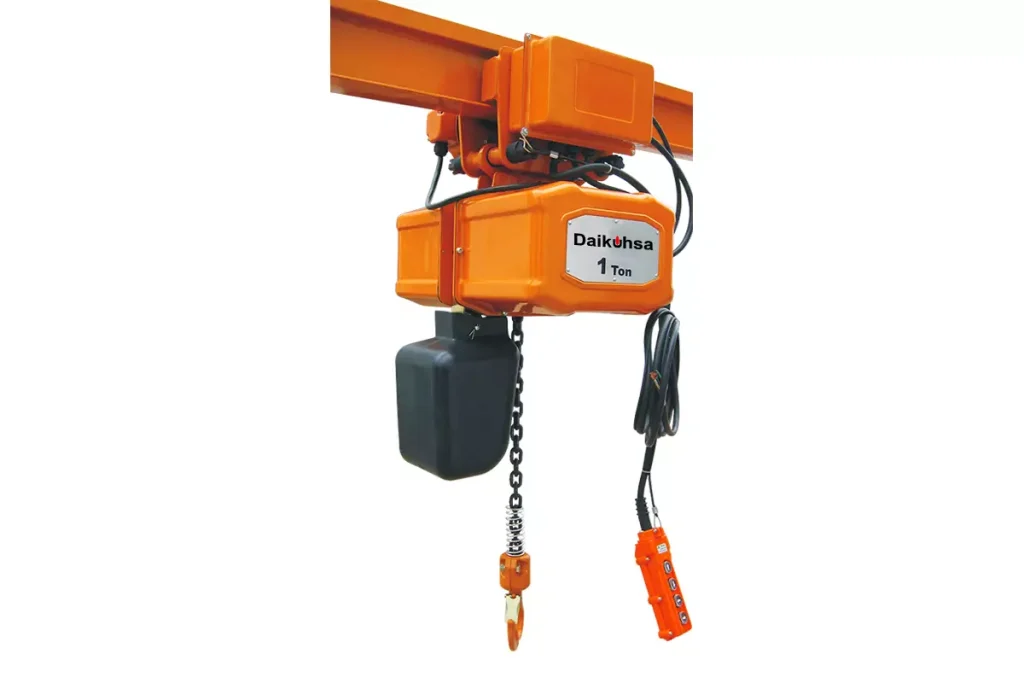
HHB 3-Phase&1-Phase Electric Chain Hoist With Trolley
1Phase/3Phase
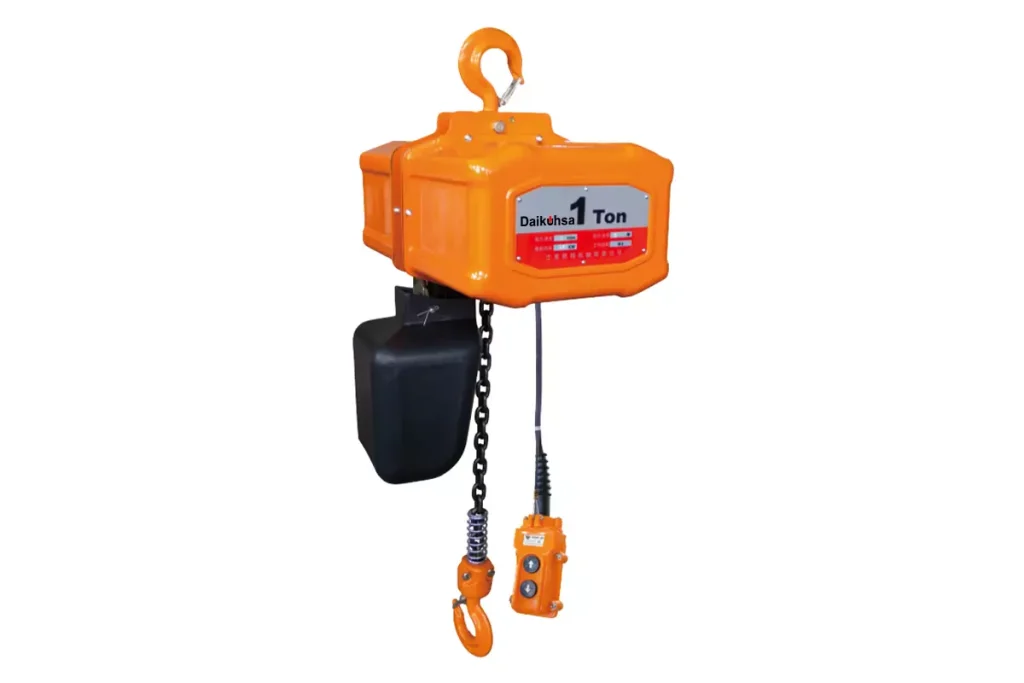
HHB 3-Phase Electric Chain Hoist
3 Phase
Why Choose Our HHB Electric Chain Hoist
Low-Headroom Design
The HHB series is built for applications where every millimeter of available vertical space matters. Its low-headroom configuration helps reduce the distance occupied by the hoist above the hook, making more usable lifting height available within a limited building height.
Trolley-Mounted Options
For applications that require both lifting and horizontal movement, HHB trolley configurations allow the hoist to travel along a suitable beam. Depending on the model, manual or electric trolley arrangements can be selected according to the required method of load movement.
Capacity for Different Loads
HHB models cover lifting capacities from 0.25 t to 10 t, providing options for lighter material handling as well as higher-capacity industrial lifting. The available capacity depends on the selected configuration and model.
Single- and Double-Speed Operation
Different lifting tasks require different levels of control. Depending on the model, HHB hoists can be supplied with single- or double-speed lifting. Single-speed operation is suitable for straightforward lifting, while double-speed operation provides a slower speed for more controlled load positioning.
HHB Electric Chain Hoist FAQs
Q: What is a low-headroom electric chain hoist?
A low-headroom electric chain hoist is designed to reduce the vertical space occupied by the hoist installation. Compared with a conventional configuration, it helps make better use of the available distance between the supporting beam and the floor, making it suitable for workshops, warehouses and production facilities with limited overhead space.
Q: How much headroom can an HHB electric chain hoist save?
An HHB low-headroom electric chain hoist can typically save around 100–500 mm of headroom, depending on the lifting capacity, hoist configuration and installation conditions. By reducing the vertical space occupied by the hoist above the hook, the low-headroom design helps provide more usable lifting height where overhead space is limited.
For accurate headroom dimensions, model-to-model comparisons or installation drawings, please contact our team. We can provide the relevant specifications based on your lifting requirements and help you choose the appropriate HHB configuration.
Q: What is the difference between an HHB low-headroom hoist and a standard electric chain hoist?
The main difference is the amount of vertical installation space required above the hook. An HHB low-headroom hoist is designed to reduce the space occupied by the hoist between the supporting beam and the hook. This allows more of the available building height to be used for lifting compared with a conventional electric chain hoist with a similar capacity.
Q: What headroom does an HHB electric chain hoist require?
The required headroom varies according to the lifting capacity, hoist configuration and trolley arrangement. Different HHB models have different installation dimensions, so there is no single headroom requirement for the entire series.
For an accurate assessment, please provide the required lifting capacity, lifting height and installation conditions. Our team can recommend a suitable HHB model and provide the corresponding dimensions or installation drawing.